
Copilots and assistants
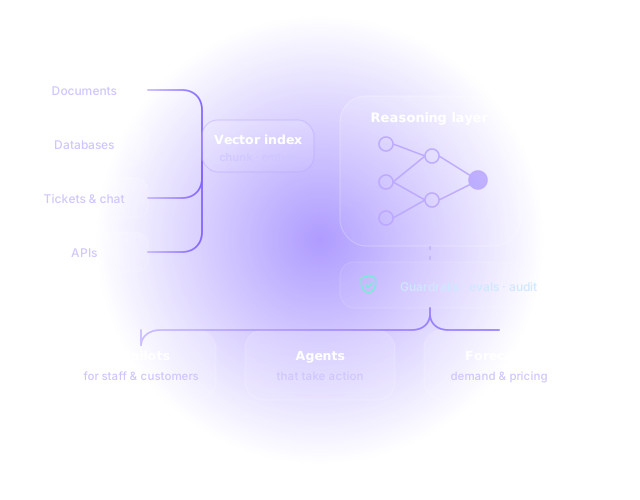
An assistant for support agents, store teams, sales or internal ops that answers from your own documentation and can act inside your systems - with a clear record of what it did.
Most pilots stall because they were never wired into a system of record. We build the retrieval, the guardrails and the integrations that turn a promising demo into something your team opens on a Tuesday morning.
Not a research programme. Working software that removes a specific piece of manual effort or answers a question people currently guess at.
An assistant for support agents, store teams, sales or internal ops that answers from your own documentation and can act inside your systems - with a clear record of what it did.
RAG done properly: chunking that respects document structure, hybrid search, re-ranking, permission-aware retrieval, and answers that cite the source paragraph.
Multi-step workflows where the model plans and calls tools - order lookups, ticket triage, data entry - with approval gates on anything consequential.
Extraction and classification for invoices, purchase orders, contracts and inbound mail, with confidence thresholds that route the uncertain cases to a human.
Demand, price and propensity models trained on your history, evaluated against the baseline you use today, and deployed where the decision is actually made.
Choosing and wiring in the model layer - hosted or self-run - with an abstraction that lets you change vendor later without rewriting the application.
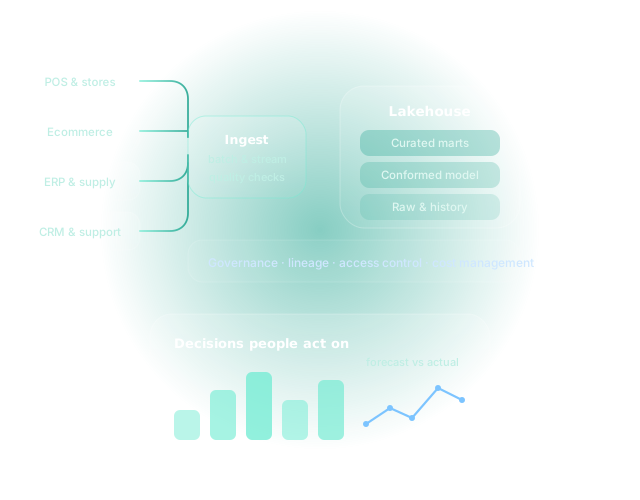
Retail AI projects usually fail on data, not on models. Knowing what an item hierarchy, a promotion, a partial return or a store transfer actually looks like in the source system is most of the work.
We score candidates on value, data readiness and tolerance for error, then pick the one or two worth building. Several usually turn out to be a reporting problem, and we say so.
Where the content lives, who is allowed to see it, how fresh it is and what shape it is in. This step decides whether the rest is weeks or months.
A narrow, working slice in front of a handful of people who do the job, instrumented so we can see what they ask and where it falls short.
A test set drawn from real questions, scored for accuracy, grounding and refusal behaviour. Regression runs on every change, so improvements do not quietly break something else.
Deployment, monitoring, cost per interaction, prompt and model versioning, fallback behaviour, and an audit trail of actions taken on a user's behalf.
Training, feedback capture, and a number agreed at the start that tells you whether it worked. If it did not, we would rather find out in week six than year two.
Answers cite their source. When the system does not know, it says it does not know rather than producing something plausible.
Anything that spends money, changes an order or contacts a customer passes through an approval step until the evidence says otherwise.
Retention, residency and access rules are part of the design, not something retrofitted after security review.
We compare against how the job is done today. An improvement that cannot be demonstrated is not an improvement.
The model sits behind an interface. Swapping provider should be a configuration change and a re-run of the evaluation set.
Everything we build is handed over in your repository, documented well enough for your team to carry it forward without us.
We will tell you whether it is an AI problem, a data problem or a process problem - and roughly what each version would cost you.